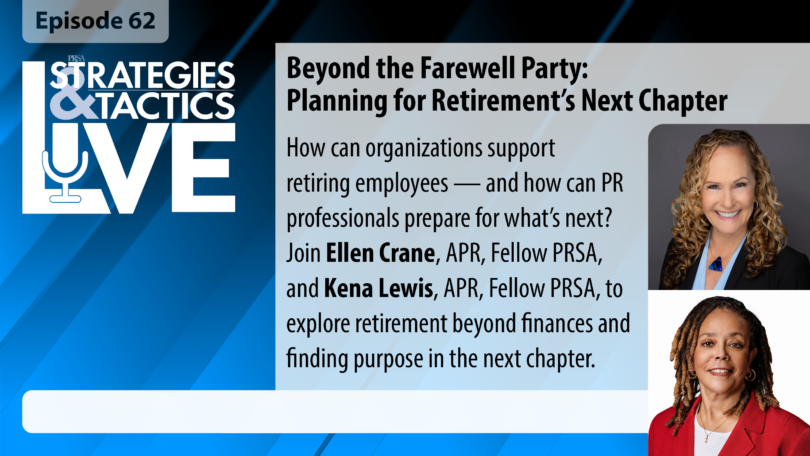
Ellen Crane, APR, Fellow PRSA, had just recovered from breast cancer treatment when she was laid off from her communications role at a healthcare company.
She was devoted to her job and thought she would work there until she retired. The company was in the process of being sold, and Crane wrote its communications plan. She had no idea she would lose the job she loved.
“It was devastating, a complete shock,” she said. “I was not prepared. I had three kids in college.” Being unexpectedly laid off “was worse than having cancer.”
A severance package gave her a small cushion, but “I was not ready to retire,” Crane said.
Crane and Kena Lewis, APR, Fellow PRSA, were the guests on Nov. 19 for Strategies & Tactics Live, PRSA’s monthly livestream on LinkedIn.
After being laid off, Crane applied for jobs, to no avail. “I learned that ageism is real,” she said. “It baffles me that more companies don’t embrace the value of a senior practitioner. They think you’re overqualified. That was really hard.”
She soon realized she had to keep going. “I couldn’t just wallow,” she said. “I didn’t have time to feel sorry for myself.”
Crane sold her house and revived her independent PR consultancy in South Florida. She earned her coaching certification.
“Luckily, I had been an independent consultant for about 15 years before joining this healthcare company,” she said. “So it wasn’t foreign to me to rekindle my business. After a year or so, my consulting business got back up to speed. I reduced my expenses and recovered. I had no choice.”
John Elsasser, editor-in-chief of Strategies & Tactics publication and host of S&T Live, asked Crane what helped her emotionally as she rebuilt her career.
“I’d been in this town for many decades and had a great support network,” she said. “You have to have a support network to get through things in life emotionally.”
She reached out to other communications agencies and her friends in PRSA, which helped her “emotionally and professionally,” Crane said. “I was able to get projects from people. I can’t say enough about networking and organizations like PRSA.”
‘Decide what you want your life to look like’
Lewis had a very different experience when she retired from Orlando Health at age 65. A decade earlier, the company had hosted a retirement seminar that showed employees what to expect and the benefits they would receive.
“It got me thinking about retirement and what I wanted to do when I retire,” said Lewis, who now describes herself as semi-retired.
For other communications professionals nearing retirement, “Decide what you want your life to look like when you retire,” Lewis said. “I wanted to retire, but I didn’t want to sit around and do nothing.”
She decided to spend time consulting, traveling, and volunteering. To boost her credentials as a consultant, she went back to school and earned her master’s degree. Lewis applied and was inducted into the PRSA College of Fellows in 2022.
Like Crane, “I cannot speak enough about maintaining your network,” she said. “A couple of them reached out to me to volunteer for the national PRSA. I loved it and had a great time.”
Before retiring, “Planning really helped me, and knowing what I wanted to do, what I wanted this next phase to look like,” Lewis said.
Even for communications professionals with full-time jobs, taking steps to make consulting your Plan B provides “a landing pad when you need it,” Crane said.
Here, Crane and Lewis offer advice for someone excited about retirement but also worried about losing a sense of identity or community: