
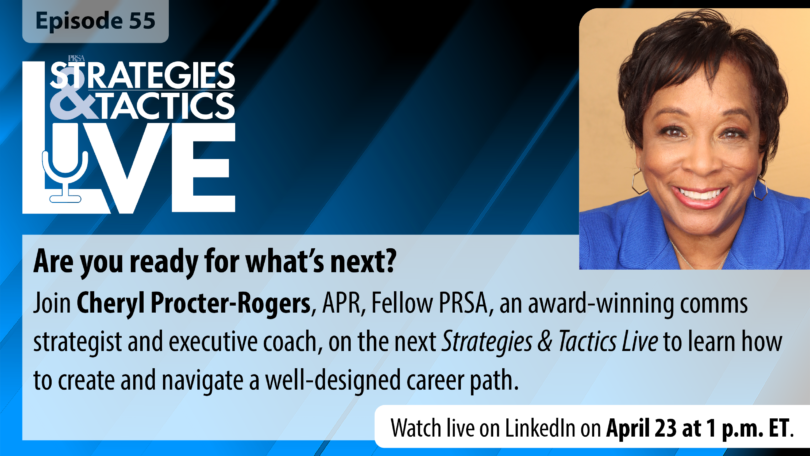
When Cheryl Procter-Rogers, APR, Fellow PRSA, asks professional communicators about their career plans, she too often hears, “I don’t have one.”
Most people in public relations still rely on outdated, linear career models, she said. “You work your way to manager, director — it was this hierarchy. That’s all changed significantly. What has not changed, unfortunately, is how few individuals have a real career plan for themselves.”
Procter-Rogers was the guest on April 23 for Strategies & Tactics Live, PRSA’s monthly livestream on LinkedIn. For the April issue of PRSA’s Strategies & Tactics publication, she wrote a piece titled “Measuring What Matters: Choosing Your Career KPIs for What’s Next.”
Your career plan should include not just what you’d like to do more of, but also what you’d like to do less of, said Procter-Rogers, president of A Step Ahead Consulting and Coaching.
“Look at trends in your industry or discipline and see where you might have gaps” in your skills, she said. “What I find most, and I was a victim of this myself, early in my career, is that you meet with your boss, and you come up with goals for the next year — what you’re gonna work on, how you’re gonna be measured.”
Instead, she suggests, create key performance indicators of your career growth and how well you’re progressing toward your career goals.
“Regardless of where you are today, as a senior executive, an entry-level individual, or even the leader or owner of a firm, what are your KPIs?” she said.
John Elsasser, editor-in-chief of Strategies & Tactics and host of S&T Live, asked about her “Four C’s” framework of cabinet, career, capabilities and community.
Procter-Rogers, who served as PRSA’s president and CEO in 2006, said she based those principles on her own career path, and what she has observed in others. During her career, she has “come to understand some of the issues that prevent us from pivoting quickly when we hit a [career] speedbump,” she said. “Often it’s the result of not having a clear career plan in mind.”
Ask yourself, “Where do you want to be in three years, or 10 years?” she said. “What do you want your legacy to be? And how does that align with your capabilities? When you think about your capabilities, what are the certificates, degrees, or experiences that are going to be impactful for your career? What are the capabilities that underpin your career plan?”
‘Personal cabinet’
Elsasser asked her to expand on her idea of a “personal cabinet,” which she had written about in August 2025.
A personal cabinet “is a group of advisers in your life,” she said, “from your personal life, your professional life, who are helping you to craft and design your career. Those individuals should know that they’re part of your cabinet. Because they’re not only your thought partners, but they’re also your accountability partners.”
When you think about where you are today in your career, and where you want to go, who do you need in your personal cabinet that will help you get there? “You want individuals you trust,” she said, “who are able to give you feedback and bring expertise to the conversation that you don’t have.”
Here, Procter-Rogers takes part in the S&T Live lightning round!







It’s really true that the old linear paths aren’t really relevant anymore. I’ve been thinking a lot about skills-based progression lately, and how important it is to continually adapt.