
Register for ICON 2026 by Aug. 14 to take advantage of the saver rate. Details here.
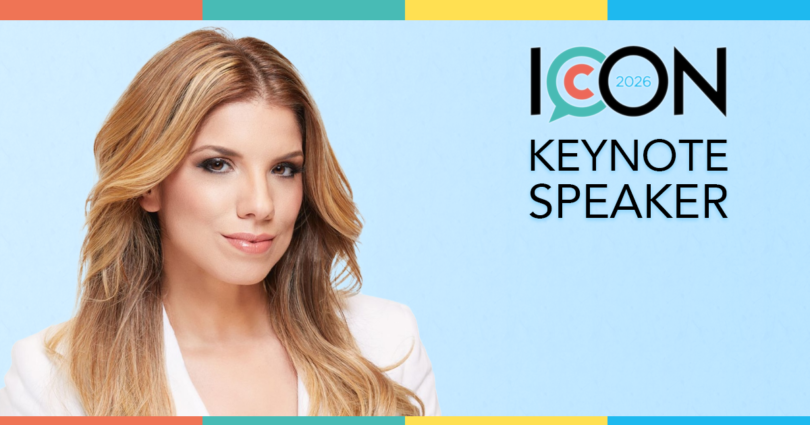
As communicators navigate rapid technological changes, shifting audience expectations and increasingly crowded information environments, few people know more about standing out than Gaby Natale.
A journalist, entrepreneur, best-selling author, and breast cancer survivor, Natale made history in 2017 as the first Latina to win three Daytime Emmy Awards. The awards honored her talk show “SuperLatina,” which she launched in 2007 in a studio she and her husband, Andy, built in a former carpet warehouse in Texas. “SuperLatina” was later picked up by the Spanish-language network V-me TV.
Through her work as a storyteller, speaker and advocate, she has inspired audiences around the world with messages of resilience, reinvention and overcoming barriers.
On Tuesday, Oct. 20, Natale will take the stage at PRSA ICON 2026 in Orlando to deliver her keynote presentation, “PIONEER: Embrace Your Uniqueness, Break Barriers and Redefine What Is Possible.”
Ahead of her appearance, Natale shared her insights with PRsay on cultivating a “pioneer mindset,” building a memorable personal brand and embracing the qualities that set communicators apart.
You’ve built a career at the intersection of storytelling, media and leadership. What sparked your interest in the power of communication?
I come from a family of lawyers, and when I was growing up, there was a fairly conservative view of career choices. Journalism, television and being on stage were not considered priorities.
Because I wanted to see the world and spoke multiple languages, I chose international relations. But during a semester abroad at the University of Westminster in London, I realized I was spending every disposable pound I had at the London Film Festival.
I returned to Argentina, graduated with a degree in international relations, then studied television production and earned a master’s degree in journalism.
What skills matter most for communicators right now?
The pace of innovation makes continuous learning essential. There are many things today that can be automated and scaled with AI. But there are also things that cannot be replicated, and that’s where our attention should go.
AI models are good at identifying patterns based on what has already been said, what has already happened and what ideas have already been shared. If all we’re seeing is the dominant pattern, how are we going to create something new? It means paying special attention to our taste, our point of view and our discernment.
In an era when we’re constantly validated by likes and engagement, the ability to be temporarily disliked is becoming an important skill. Sometimes having a point of view means expressing an opinion that may not be immediately popular. If we’re fulfilling our responsibility as communicators with an open heart, we need to cultivate the ability to withstand that discomfort.
Your work helps people and organizations stand out in crowded environments. What mistakes do communicators make when trying to differentiate themselves?
Even when communicators are trying to differentiate themselves, they’re often playing it safe. They’re pursuing the same opportunities, targeting the same audiences, chasing the same messages or adopting similar styles of delivery.
That’s what I call the “emulator mindset” — when we look around, see what everyone else is doing, and then set our future goals based on someone else’s past results. Emulators don’t move the world forward. They perpetuate the status quo.
What we’ll talk about in Orlando is the opposite approach, what I call the “pioneer spirit” — the idea that we must believe in our vision before we have results to validate it.
What’s your advice for communicators who want to strengthen their own personal brands and build their professional visibility?
Make full use of all the tools available to us today. When I graduated in 1995, everything depended on gatekeepers. That’s no longer the case. Not all of us had these opportunities when we started our careers, and even today many people aren’t taking full advantage of the opportunities available to them.
Technology now allows our voices, ideas and messages to travel farther than we can imagine. That’s something I emphasize when I train professionals at Fortune 500 companies and organizations around the world.
Don’t underestimate the power of your voice. Don’t underestimate the power of your story. You can create an impact that you can’t even imagine today.
No matter where you work, chances are, you’re operating in a crowded environment. There are many talented people competing for limited opportunities. So how do you stand out? Part of it is doing great work and striving for excellence. But another part is developing a style of your own. And how do you develop your own style if you’re never willing to take risks?
If you visit the Pablo Picasso Museum in Barcelona, you can see his entire artistic journey. His earliest paintings reflect what I would call an emulator mindset. They resemble the work of many other artists of the era — similar subjects, similar techniques and similar approaches.
But over time, you can see a deliberate decision to view himself and the world differently. That’s when the first hints of Cubism begin to appear. By the end of the museum, it’s clear that Picasso created an entirely unique style. But that only happened because he gave himself permission to take risks and express himself fully.
What a loss it would have been if he hadn’t allowed himself to explore his full potential and creativity. That’s the message for all of us. We need to give ourselves permission to express our own potential and greatness.
There may be an equivalent of Cubism in your profession, your craft or your delivery. There may be a spark that only you possess. If you’re simply imitating what everyone else is doing, you’ll never discover it.
Here, Natale shares one idea that she hope PRSA ICON attendees will take away from her keynote: