
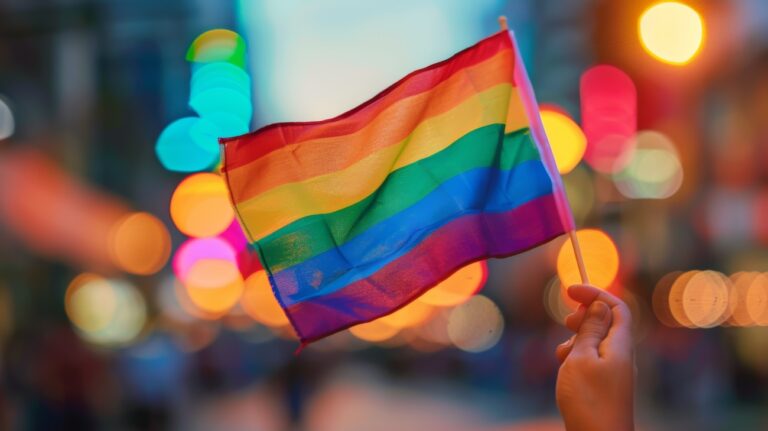
Every June, communications teams scramble. Logos get “rainbow-fied,” social calendars get stuffed with LGBTQIA+ focused content, and press releases go out with phrases like “we stand with” and “we celebrate,” but nobody stops to ask the most basic question.
Do you actually know this audience?
You may know the demographic profile, but do you know the people? Where we live online? Who shapes how we think? What we’ve fought for and what we’re watching brands do right now?
That question has serious stakes. Considering the political headwinds around diversity, equity, and inclusion are as volatile as ever, the pressure on brands to go quiet is real. And so is the cost of getting this wrong — in both directions.
How do you do your homework? Get to know your public:
Know where we are.
We’re on TikTok, and there’s a reason for that. Feeling safe and understood in at least one online space is associated with lower suicide risk and lower rates of recent anxiety for all LGBTQIA* young people, and for LGBTQIA+ young people of color in particular. Research from the Trevor Project suggests TikTok has become one of those spaces for many LGBTQIA+ young people.
Queer creators describe TikTok as a platform that delivers content tailored to your interests and identity — one that becomes a space for people to come together and connect in ways that feel more individual and intimate than anywhere else. For the LGBTQIA+ community, the For You algorithm goes beyond offering entertainment or educational content – it offers a safe community, especially for those in environments where being out carries real risk. For many, it is their lifeline.
GLAAD’s 2026 Social Media Safety Index found that with the exception of TikTok, platform scores dropped across the board — hitting historic lows for Meta, X and YouTube in their protections for LGBTQIA+ users. TikTok maintained strong protections for LGBTQ people in its Community Guidelines while other platforms rolled them back.
When every other platform pulls up the welcome mat, the community moves toward the one that keeps it out. That migration is cultural intelligence your client needs.
So when a brand asks where to show up, the answer in 2026 is specific, and it requires understanding what kind of presence earns trust in a space the community built for itself.
Know who shapes the conversation.
This community has never been one audience. The creators shaping it reflect that, each one speaking to a different intersection of identity, experience, and platform.
The creators who carry cultural weight in this community build it through proximity, authenticity and consistency.
- V Spehar (@underthedesknews) has built a community of over 5 million between TikTok and Instagram by breaking down current events with clarity and empathy. They have covered gender-affirming care, Gen Z voter engagement, and major political moments in a voice the community trusts. That trust took years of consistently showing up as themselves, unapologetically.
- Brielle Winslow-Majette (@thats_y_yuh_wins_low ) first built her TikTok following by challenging beauty norms and advocating for the representation of women with PCOS. She is now the first (Acting) Black executive director of Garden State Equality, presenting on LGBTQIA+ policy at Rutgers, while continuing to create content that reaches her community directly. Her audience follows her because she’s never performed her identity for a brand. Any partnership that asks her to would show.
- ALOK (@alokvmenon) has performed in over 40 countries, sold out the Edinburgh Fringe Festival, released a comedy special executive-produced by Christopher Guest, and had a documentary about their life executive-produced by Jodie Foster at Sundance. Their TikTok moves between poetry, provocation and cultural commentary.
- Matthew and Paul (@matthewandpaul) are a gay couple whose TikTok is built around one of the most underrepresented intersections in LGBTQ+ content — love and disability. Matthew has Retinitis Pigmentosa, leaving him with 95% vision loss. Their daily life together as an interabled couple is the engine of everything they create, and they have extended that platform into LGBTQ+ children’s books, writing stories that reflect families like theirs.
- Eden & Jay (@edenxjay) are a queer Latina married couple and new parents whose TikTok documents life at the intersection of love, culture and family. When gay marriage became legal throughout Mexico, they returned to Oaxaca — one of the country’s most traditionally indigenous communities — to get married. They also host Preciosa Night, one of the largest queer Latina events in the country.
Follower counts are easy to find but the cultural context — why the community connects and why it matters to us — takes actual research and understanding.
Know your own people.
There’s one audience most Pride briefs skip entirely: the LGBTQIA+ employees already inside your client’s organization.
A SurveyMonkey poll of more than 2,000 LGBTQIA+ adults and allies found that around 40% consider a company’s gravest Pride error to be overlooking internal issues such as discrimination, harassment, or the absence of inclusive policies. That ranked higher than insensitive marketing campaigns. Higher than failing to include LGBTQIA+ voices in external communications.
Around 34% of respondents don’t believe companies listen to LGBTQIA+ perspectives when planning for Pride at all.
One group consistently missing from both internal and external Pride communications: LGBTQIA+ Latinos. The U.S. Latino LGBTQIA+ population is large, growing, and largely invisible in brand strategy — addressed in Spanish only when budgets allow, and rarely with the cultural specificity that actually earns trust. That gap is worth naming in the brief before someone else does.
The most genuine initiatives are educational panels, workshops, and gathering feedback from the community before June 1, not after.
If a client’s external Pride messaging is stronger than their internal reality, that gap will surface quickly. It always does.
Know your resources.
Two resources every communicator should be familiar with:
- The HRC Corporate Equality Index is the most authoritative benchmark for LGBTQ+ workplace inclusion in the country. In 2026, 108 Fortune 500 companies earned a perfect score of 100. Pay particular attention to how your client scores on transgender and nonbinary inclusion, as those numbers consistently lag behind the overall CEI score. That gap is exactly what the community is watching. If your client is on that list, that’s a credibility asset worth knowing about. If they’re not, it’s a strategic conversation worth having.
- The GLAAD 2026 Social Media Safety Index is required reading before advising any client on platform strategy this month. The sixth annual evaluation covers TikTok, YouTube, X, and Meta’s Facebook, Instagram, and Threads — assessing each platform’s policies on LGBTQIA+ safety, privacy, and expression. If you’re recommending where a client shows up, you should know which platforms the community trusts and why.
Two more worth bookmarking: the 2026 Curve Power List, published annually during Lesbian Visibility Week, and OUT100, Out Magazine’s annual since 1994. Between the four, you have your platform strategy, your workplace benchmarks, your influencer research, and your cultural landscape.
Most Pride briefs are built backward. The message comes first and the audience comes second, if at all. Flip that order and suddenly the platform strategy, the partnerships, the tone, the timing all make sense in a way no approved messaging list can manufacture.
June is the deadline. The homework was due months ago.
Andrea Gils Monzón is a strategic communications consultant, PRSA Board member, and founder of Shiftmakers Agency. She counsels organizations at the intersection of AI, ethics and marketing communications.
Photo credit: hooyah808





That’s a really important point. It’s easy to just put out rainbow graphics, but truly understanding what matters to the LGBTQIA+ community is what makes any campaign authentic.