Artificial intelligence agents “represent a meaningful shift in how public relations work is performed,” said Mark McClennan, APR, Fellow PRSA.
Agentic AI that works autonomously on behalf of human users can “do more than respond to prompts like you’ll see with ChatGPT or Claude,” he said. “You give them a task, and they figure out how to get it done.”
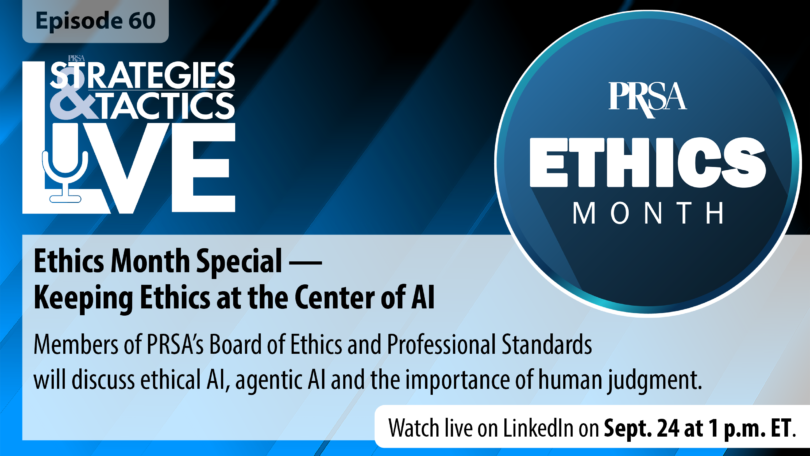
McClennan was one of four panelists who joined host John Elsasser for the Sept. 24 edition of Strategies & Tactics Live, PRSA’s monthly livestream presentation on LinkedIn.
September is Ethics Month for PRSA. In July, its Board of Ethics and Professional Standards released an updated advisory about the use of AI agents in public relations.
“Agents pursue goals and complete tasks on behalf of the end-user, often using capabilities such as reasoning, planning, memory, tool-use, and adaptation,” McClennan said, quoting the advisory that he led. “The systems can monitor media, generate and distribute content, engage stakeholders, coordinate workflows, trigger responses, and supervise other agents across communications functions.”
McClennan said he uses AI himself, but cautioned that “Artificial intelligence is not an ethical actor. It has no moral judgment, no professional obligations, and no reputation to protect.”
Human beings must safeguard the ethical use of AI in communications, he said. Public relations professionals should disclose when they use an AI agent if that use materially affects communications. He urged communicators to continually monitor AI outputs for bias and fairness.
“Don’t use AI agents to impersonate individuals, simulate consensus, or conceal sponsorship,” McClennan said, quoting the advisory.
‘Understanding our own value’
Panelist Linda Staley, APR, Fellow PRSA, is chair of PRSA’s 11-member Board of Ethics and Professional Standards. With the emergence of AI tools in the communications field, the board has turned its attention to providing guidance on their ethical use, she said.
“It’s all based on the PRSA Code of Ethics, which is almost as old as the Society itself,” Staley said. “We are translating and interpreting the Code through the lens of contemporary issues and tools.”
Elsasser, editor-in-chief of PRSA’s Strategies & Tactics publication and host of S&T Live, asked how PR professionals should reconsider ethics in their everyday decisions, given the massive changes AI has brought to the industry.
“With our increasing use of AI, it’s challenging us not just to learn to use the tools responsibly and ethically, but also to understand our own value,” Staley said. “If we’re able to use AI to do many of the tasks that we used to do, then what is our value to our employers? It is our ethical judgment, our humanity, our ability to reason and our ability to create communications that inspire trust.”
Panelist Marlene Neill, Ph.D., APR, Fellow PRSA, is an assistant professor at Baylor University in Waco, Texas, and a member of the Board of Ethics and Professional Standards.
She described a “perfect storm” in which communicators are pressured to work efficiently but have not received proper training or ethical guidelines on how to use the AI tools that promise that efficiency.
“These are ingredients that could result in a serious crisis for an organization,” Neill said. “We need to have the guidelines and the training so that we use these tools responsibly.”
Elsasser asked about the critical thinking that communicators must exercise when using AI.
“The basic journalism skills that we began with, where you question information and are skeptical of what you’ve been provided with, and you make sure that what you’re looking at is accurate,” Neill said.
Panelist Lea-Ann Germinder, Ph.D., APR, Fellow PRSA, is also a member of the Board of Ethics and Professional Standards.
“We have been told for decades that we need to not only serve our organizations, but to serve the public,” she said. “In the age of AI, that responsibility extends to serving humanity.”
Her research has underscored the importance of learning ethical literacy while using today’s new AI tools.
“You can’t learn about the tools and not have ethical decision-making about using them,” Germinder said. “You need both of those together.”
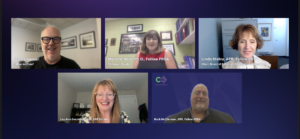
Here, the panelists take part in the S&T Live Lightning Round. (Mark McClennan had to leave early for another PRSA event.)