
When work feels overwhelming, “Pick up the phone and call a friend,” said Mark Mohammadpour, APR, Fellow PRSA. “Tell somebody that you need an ear, and share that you’re frustrated. You don’t expect them to have a solution. You just need to get it out.”
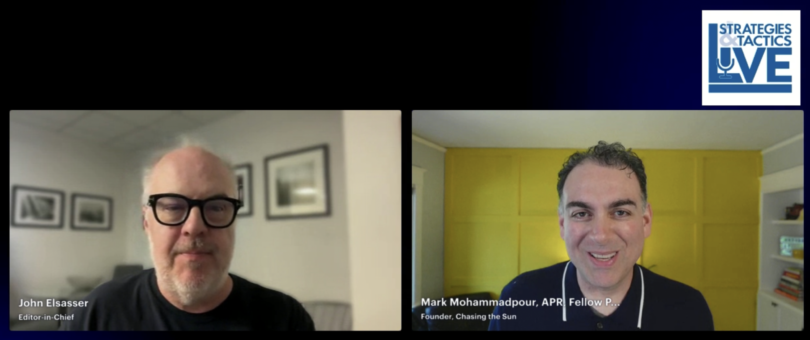
Mohammadpour is the “Workplace Wellness” columnist for PRSA’s award-winning publication Strategies & Tactics. He was the guest on June 24 for S&T Live, PRSA’s monthly livestream series on LinkedIn that goes deeper into the topics covered in the publication and on PRSA’s PRsay blog.
Public relations professionals often feel stressed navigating a tumultuous world, “especially in this awkward, remote, hybrid, asynchronous era,” Mohammadpour told John Elsasser, editor-in-chief of Strategies & Tactics and host of S&T Live.
“The good news is that our industry is here to stay,” he said. “But how do we ensure that PR professionals are staying connected, confident, and healthy? These things impact our sleep” and overall well-being.
After spending 20 years in agency PR at Weber Shandwick and Edelman — during which he lost and kept off 150 pounds — Mohammadpour founded Chasing the Sun, his communications and health-coaching agency.
“This era of asynchronous communication,” when people communicate without seeing each other’s faces, “can be very draining,” he said. “Having a real-time conversation with somebody is something we don’t always default to today.”
“Humanizing one another seems basic, but we sometimes forget that,” he said.
When work begins to feel overwhelming, “think about all of your obligations and break them up into buckets,” Mohammadpour said. “One bucket should be the things that are essential and that you have to do right now. Another bucket contains things that you have to do, but not right now. Another holds things that you can delegate.”
Remember that “not everything is urgent, and we can’t do it all at once,” he said.
That same principle applies to career planning.
“You have a long list of things to do. What’s important, what’s tied to your goals, what’s important for the business? These are conversations you need to be having with your manager on a regular basis.”
Small wellness changes make a big difference
“The work that we do can be exhausting,” Mohammadpour said. “We’re burned out by pitching the media. We’re burned out by supporting an executive. We’re burned out by crisis. We may be advocates for the brand; we may even have a good balance on the number of hours or days that we work, but the type of work that we do can cause burnout as well.”
Elsasser asked what small changes communicators can make in how they manage their work that will improve their workload, energy and mood.
“Defaulting to 30-minute or 60-minute video meetings can be exhausting,” Mohammadpour said. “A quick thing to change, whether you’re running meetings or participating in meetings, is to suggest having some camera-off meetings instead.”
If you’re on a one-to-one call, “leave the house and go for a walk,” he suggested. Better yet, he said, take a 20-minute walk each day without your phone. “Also, good-quality sleep is underrated.”
Making these changes might seem small, “but over time, they help immensely,” he said.
Here, Mohammadpour takes part in the S&T Live lightning round!