
In a world overwhelmed by messages, being boring isn’t simply ineffective. It can actually hurt your brand.
Branding expert and author Sally Hogshead delivered that central message during her General Session presentation today at PRSA ICON 2026 in Orlando, Fla.
Hogshead challenged communications professionals to reconsider how they capture attention, arguing that the strategies that once helped build recognizable brands no longer guarantee an audience.
“When we lived in an unsaturated world with three channels, you could have a boring message because people were so desperate for any kind of stimulation that they would listen to you,” she said.
Brands such as Kellogg’s and AT&T benefited from an era when repetition and consistency were enough to establish recognition. But today’s audiences face a constant stream of competing information.
“If you have a boring message, you’re actually damaging your brand because people are less likely to listen to you the next time,” Hogshead said.
Her advice was straightforward: “Stand out or don’t bother.”
Give audiences a reason to care
Hogshead said the need to communicate in a compelling way extends beyond advertising and public relations.
Even everyday conversations, including those around the dinner table, can benefit from moving past routine exchanges and addressing what people genuinely think and feel.
For organizations, she argued, the most valuable brands don’t simply repeat messages. They communicate what they believe.
“The most intensely valuable brands express their beliefs consistently, persistently, insistently and courageously,” she said.
To help communicators develop stronger messages, Hogshead offered a three-part framework built around relevance, urgency and a clear reason to act.
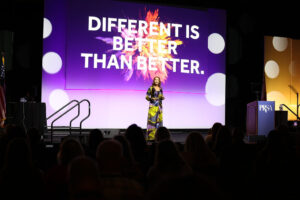
To help communicators move past generic claims, Hogshead offered a simple three-part formula for building messages that demand attention. Every strong pitch or campaign, she argued, must establish immediate relevance by defining a clear audience benefit, convey urgency by explaining why it matters right now, and define sharp positioning by showing why that specific organization is uniquely qualified to solve the problem.
Stop trying to be everything
Another challenge, Hogshead said, is the tendency to combine conflicting messages to appeal to everyone. She illustrated the problem with a dog analogy.
A watchdog has a clear purpose: protection. A lap dog has an equally recognizable role: companionship and charm. But when communicators try to combine an aggressive message with an overly friendly one, the result can become muddled.
She pointed to the familiar corporate phrase “We’re pleased to announce” as an example of language that often fails to establish a distinctive point of view.
To make the lesson more memorable, Hogshead introduced attendees to her own dog, Bob Ross.
Named for the late television painter, Bob Ross has become something of a branding experiment in her household.
Hogshead described how she and her family embraced the dog’s resemblance to his namesake, giving him a goatee-like haircut and even grooming a painter’s palette onto his backside, with his tail serving as the paintbrush.
Over time, Bob Ross has appeared in other elaborate looks, including Willy Wonka, Tigger and a Key West-inspired parrot.
Rather than combining unrelated qualities into a message that tries to please everyone, Hogshead encouraged communicators to identify what makes a person, organization or brand distinctive — and build from there.
From one of many to the only one
Hogshead also introduced her Fascination Advantage assessment, a tool she developed to help people understand how others perceive them when they’re at their best.
She noted that her work developing the assessment included clients such as NASA.
For PR professionals navigating an increasingly crowded communications environment, Hogshead’s message was clear: Familiarity alone is no longer enough. Organizations need to communicate what matters to their audiences, why it matters now and what makes them different.
She summed up that challenge with a call to action:
“Refuse to be one of the many. Start being the only.”
Photos by Albert Chau