
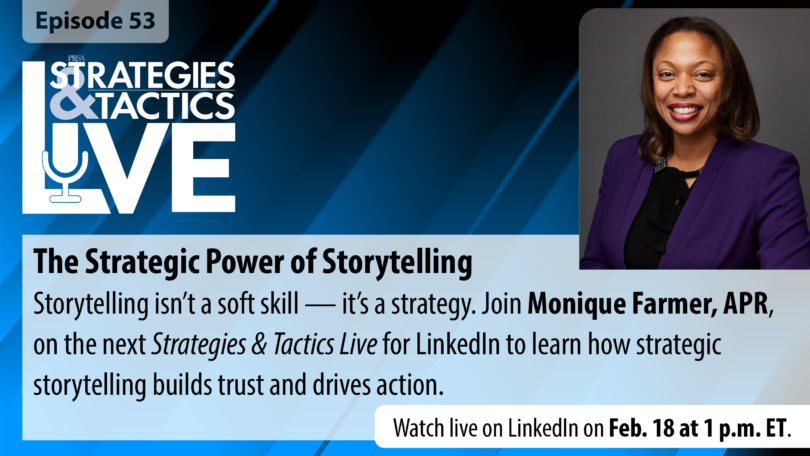
Stories that capture people’s attention express “who we are as primal human beings,” said Monique Farmer, APR. “When we get engaged with a story, we’re going through that adventure with those characters that we’re starting to build a connection with.”
Farmer is an author, strategic communicator, educator and entrepreneur. She was PRSA’s guest for Strategies & Tactics Live on Feb. 18. A frequent contributor to PRSA’s Strategies & Tactics publication, she wrote the piece “Strategic Power: Why Storytelling Drives Trust and Action,” for the February issue.
“When the characters in a story are in tension, we’re in the tension with them,” Farmer said. The stress hormone cortisol starts to release in our brains, “like we’re going through it with them. And then the next hormone that we typically see unfold in this scaffolding process of storytelling is oxytocin, the bonding hormone that gets us to a place of empathy.”
By the end of the story, “if it’s done well, we get to a phase where we are releasing the feel-good hormone dopamine, because life’s back to normal, or that person’s living happily ever after,” she said. People react emotionally to stories “because we’ve built that connection and we have this hormonal release that gets us directly engaged and focused on that story.”
John Elsasser, editor-in-chief of Strategies & Tactics and host of S&T Live on LinkedIn, asked Farmer how communicators can responsibly use this neuroscientific approach to storytelling.
“As we consider the responsibility that we have as communicators, we want to be cognizant that we’re not misleading our audience, especially because we’re talking about a framework that’s pretty universal,” she said.
In the age of artificial intelligence, “If we’re not finding unique, real stories, or at least being grounded in an aura of truth, to be able to relate to people on a real-world basis, we’re gonna quickly lose trust — especially if they discover that we haven’t disclosed that we’re taking advantage of some of these technological resources that we have at our fingertips.”
Citing the books “Made to Stick” by Chip Heath and Dan Heath, and “Stories that Stick” by Kindra Hall, she offered a strategic storytelling framework that includes five main points:
- Introduce relatable characters
- Show the challenge, with emotion and details that appeal to the senses
- Reveal the turning point in the story
- Paint the new reality for the audience
- Tie the story back to purpose
Story themes for professional communicators might include the value that an organization brings to its customers or the community, or stories about company founders and their purpose.
When pitching stories to the news media, “We’re not gonna get a reporter excited about coming to an event for a new product announcement if we don’t show them what’s in it for the community, or the impact that it makes, or how it made life better for someone already,” Farmer said.
“We have to be in the audience’s shoes and know what their fears and their motivations are, and speak to those.”
Watch Monique take part in the S&T Live lightning round:
Watch the full episode for more storytelling insights.