Register now for ICON 2026 in Orlando, Fla., from Oct.18-20. Register by Dec. 31 and save.
Attending PRSA’s ICON 2025 in Washington, D.C., for my first time, and during a federal government shutdown, felt like a bold, maybe even reckless decision.
As a nonprofit senior manager and leader, this year has been packed with bumpy federal budget advocacy, emergencies and last-minute executions. Adding a trip to the nation’s capital for a conference? That should’ve felt like a mistake.
But it wasn’t. In fact, the conference was one of the most unexpectedly energizing moments of my year.
Because here’s the truth: Leading in communications often means absorbing crises, managing expectations with scarce resources and constantly proving our worth in rooms where strategy is defined by numbers, not narratives. Over the years, my PR career has given me some amazing moments. But it’s also taken a toll. I’ve sometimes felt let down by systems, by people, by outcomes.
And yet, ICON gave me insight and stamina. And in a year marked by national gridlock and personal fatigue, that felt like a lifeline. Here are the moments, sessions and ideas from ICON that reminded me why I am still walking this path.
Reputation, recognition, real talk
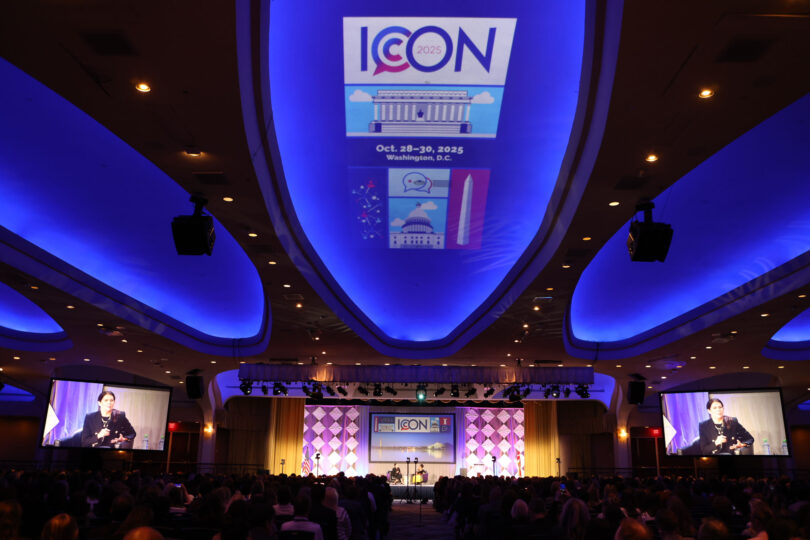
The Opening General Session at ICON was more than a welcome. PRSA set the tone by reminding us of the deeper purpose behind what we do: building reputation, advancing the field and mentoring the next generation.
Watching trailblazers receive honors reminded me that the communications profession has legacies. Hillary Fussell Cisco, APR, professor of public relations at Quinnipiac University, was named PRSA’s 2025 Outstanding Educator.
Jane Dvorak, APR, Fellow PRSA, president of the PR firm JKD & Company, received the 2025 David Ferguson Award, which honors the late David Ferguson for his outstanding support of public relations education as PRSA president in 1985 and co-chair of the PRSA Educational Affairs Committee.
The Opening General Session also brought service and commitment to the forefront. Ronelle M. Dotson, APR, Fellow PRSA, presented the 2025 College of Fellows. For his 37 years of dedication to communications and mentorship, particularly as a Navy captain, Brook DeWalt, APR+M, Fellow PRSA, accepted the Patrick Jackson Award for Distinguished Service to PRSA.
Then came the keynote speech by actress, producer and writer Lauren Graham — a name I didn’t expect to see at a PR conference. But hearing her talk about storytelling, imposter syndrome, and finding joy in creative practice was something I didn’t realize I had needed.
Graham spoke about empathy as if it’s a strategic asset. She reminded us that our voice, when used with purpose, is a form of power.
Crisis as a constant
For communicators, crises are constant. Speaker Robyn Patterson didn’t sugarcoat anything. Their experiences in political comms — from the White House and Congress to campaigns — underscored the brutal clarity that communicators need in a crisis. Rip up your editorial calendar. Focus on your nonnegotiables. Get leadership buy-in fast. Say what needs to be said, even when it’s uncomfortable.
What stuck with me most was the idea that every crisis — no matter how big or small — is a test. We either pass that test or lose our audience.
In my world, where scrutiny is another constant, this session helped reframe crisis not as an interruption, but as an opportunity. How we show up in the hard moments defines us and our values more than the campaigns we win.
AI and PR
I came into one of the AI sessions feeling skeptical. Like many of us in various professional fields, I have been overwhelmed by the glut of AI resources. But what I heard shifted my mindset to strategy.
With 70% of Google searches now ending without a single click, our content isn’t just competing for eyeballs; it’s competing to be cited by an algorithm.
The session also emphasized that while AI can amplify, it can’t replace the emotional intelligence and cultural perspectives that we bring to our work.
Loss of civility, connection
If there was one ICON session that felt like it was speaking directly to this moment in America — in our politics, our social media feeds, our workplaces — then it was the session on civility.
The data presented was stark: Incivility is rising, and it’s costing us emotionally, mentally and socially. But the conversation offered a path forward: Communications professionals are not just crafting messages and engaging audiences; we’re modeling the discourse that we wish to see in the world.
Innovation archetypes
The session on intrapreneurship and innovation archetypes gave me language I didn’t know I needed. I’ve always identified as a Builder: someone who works within systems to push them forward. But now I have a name for it: I’m a Synthesizer, where ideas meet structure and vision meets execution.
This session didn’t just offer a fun self-reflection. It was a call to action. Innovation isn’t just about ideas; it’s about teams that bring different strengths. And as someone who often carries too much alone, I was reminded to lean on others and to build smarter, more diverse, more resilient teams.
The power of visibility
In a polarized political world, it can feel risky to say anything, let alone take a stand. But this session clarified that visibility, authenticity and courage are still the currency of influence.
Panelists cited as models Biden Transportation Secretary Pete Buttigieg’s frequent public appearances, and U.S. representative Alexandria Ocasio-Cortez (D-NY) for her grasp of tailoring messages for specific audiences.
Walking into ICON, I was tired from the grueling news headlines, the politics, the thankless weight of always being the one who “keeps it together” behind the scenes. But after the conference had concluded, I took the train back home feeling reinvigorated. Not because all my work and professional problems were solved. But because I remembered what this work is really about: truth, trust, resilience and tenacity.
And because I saw — in panels, in conversations, in award speeches — that even amid the messiness, there is community. My first ICON was more than a break from my routine. It helped me reconnect to my purpose as I start the second act of my career. And for that, I’m grateful.
Carmen Boon is vice president of public affairs at Food Bank For New York City, the city’s largest hunger-relief organization, where she advances the mission of ensuring food security for good. With a career spanning government, nonprofit and media environments, Carmen leverages storytelling, data-driven narratives and native media platforms to drive civic engagement, shift public perception, influence policy and secure funding for social impact.
ICON photo: albert chau