Register now for ICON 2026 in Orlando, Fla., from Oct.18-20. Register by Dec. 31 and save.
As chief brand and marketing officer at SHRM — the world’s largest business association focused on workplace dynamics — Tina Beaty helps organizations and their leaders anticipate what’s next in the world of work.
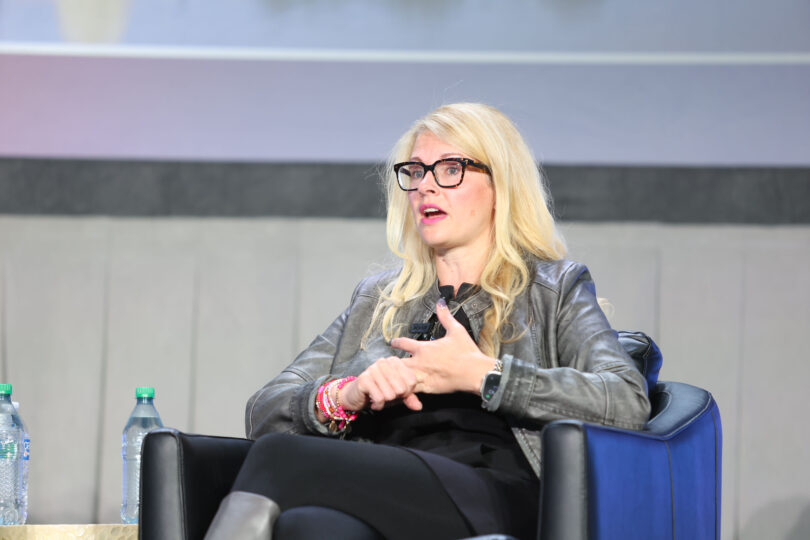
Following her General Session on Oct. 28 at PRSA’s ICON 2025 in Washington, D.C., she spoke with PRsay about hybrid work, employee morale, the impact of AI and what’s ahead for communicators in 2026 and beyond.
The conversation about remote work and hybrid work continues. How do you envision the future of hybrid and remote work, and the role of internal communicators in that conversation?
Each organization needs to figure out what works best for their culture. Then they need to clearly communicate it. And that’s where a good communicator can jump in and articulate the “why” behind it, the pros and cons, and how employees should embrace the change, if there is a change, in their work schedule.
I looked at research that showed 71% of U.S. workers want flexible schedules. Is there a point where there’s only so much internal comms or HR can do to communicate the organization’s stance on scheduling?
Well, what does flexibility mean? If you would like to leave and work a part-time schedule that [gives you] time to do laundry and yoga, then you need to arrange a part-time job. If your idea of flexibility is to be able to show up to school meetings, back-to-school nights, or a doctor’s appointment, then an employer should work with their employees to fit that in.
At SHRM, we don’t believe in the term “work/life balance,” because we think it’s too amorphous in what it means to folks. We call it “work/life integration,” which says you’re going to work as hard as you possibly can and still show up fully for the people and commitments in your personal life as much as you can, right? Those things have to meld.
What are the challenges in maintaining cohesion and purpose when everyone is not in the same physical space? What steps can leaders take to create a unified feeling when teams are scattered?
It takes effort to make that work, right? You have to make sure you have the technology to facilitate these conversations. Because if the online workers can’t hear or participate, then they feel alienated. That’s why a lot of CEOs and CROs advocate for at least some level of hybrid [work].
You have to make sure expectations are clearly outlined. What are the expectations for in-person and remote workers? And how do you facilitate relationships, even though there’s a screen between us? How do managers bring their hybrid teams together?
We need to be taking that extra level of effort to bring those teams together, to have check-ins, to build camaraderie, so that when we do snap into a meeting, it can be all business, because we’ve already established those personal relationships.
What is SHRM seeing now in terms of employee morale? We keep reading about “coffee badging,” “quiet quitting” and other workplace trends.
Our data shows that those trends are real, right? But there is a majority of workers who are here to build careers, who have found purpose in their jobs, who are dedicated to their employers, the work that they do, the teams that they’re on.
There is a substantial number of workers who want to create great companies, great workplaces. And I think employers are choosing to focus on those folks and build companies around them.
Looking ahead to 2026 and beyond, what workplace trends do you foresee?
We have to say “AI” whenever we’re talking about change, because it will impact every role. It does not matter what you do, from janitor to intern, to accountant, to PR person, to CEO; your role is going to be fundamentally changed because of AI.
It’s going to start with generative AI and some simple automation for your tasks. But it is going to quickly amount to more. Individual workers need to get in front of it and own it. Don’t wait for your employer to say, “You need to learn this,” or “You’ve been automated out of a job.” Learn it now. We need to try to own [AI], control it, maximize it, as best we can.
How can leaders communicate that message and help their teams overcome trepidation about artificial intelligence?
Change is the only constant that humanity has had. So, why would we fear this change? This technology is just another change that we need to harness. It is not going to wipe out humans or humanity, even as robots become your coworkers, right?
Here, Beaty discussed more key changes that SHRM believes will shape the workplace next year and beyond:
ICON photo by albert chau