
Public relations relies on “voice, trust and reputation,” Andrea Gils Monzón said. “If we stay passive, ethics get outsourced to AI tools that don’t understand values, context and consequences.”
As AI has evolved following the November 2022 public debut of the ChatGPT chatbot, communicators are reminded that “AI is not managing the risk,” she said. “We people, we practitioners, are doing that.”
Gils Monzón was a guest for the Jan. 27 episode of Strategies & Tactics Live, PRSA’s free, monthly livestream on LinkedIn.
During ICON 2025 in Washington, D.C., last October, PRSA released an updated version of the guide “Ethical Use of AI for Public Relations Practitioners,” which builds on its 2023 guidance.
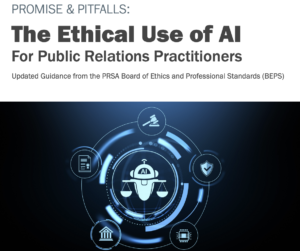
The document reframes PR pros as “active governors of AI, not necessarily cautious users,” said John Elsasser, editor-in-chief of PRSA’s Strategies & Tactics and host of S&T Live. The guidance is “a structured, how-to handbook,” he said.
“In our world, you have to use AI,” said guest J.R. Hoeft, APR, MBA, a member of PRSA’s Board of Ethics and Professional Standards who helped create the revised edition. “If you’re not using it as a PR practitioner, you’re committing professional malpractice.”
Gils Monzón, a PRSA Board member and part of the AI working group, said input from PRSA members and her own clients and team members helped shape the updated guidance.
Among their questions about AI were: “When do I disclose it? As a human, at what point am I involved? And how do I talk to clients about AI without them losing trust or devaluing our work?”
Elsasser said the importance of transparency regarding AI use has been elevated in the updated guidebook, and that “disclosure was a top-of-mind issue” for PR professionals.
“Humans are in the driver’s seat with AI,” Hoeft said. “You are ultimately making the decision. The ethics, the value that we have as public relations practitioners, have not changed.”
Costs and benefits of AI
Elsasser asked about the ramifications of using AI on creativity, ethics and reputation.
PR practitioners “still need to know how to write,” Hoeft said. “We need to know how to analyze a narrative. We have to know how to pick out messages that are important and are going to resonate with the public.”
With the updated guidelines, “We wanted to ensure that the human being and their creativity and their innovation is still the centerpiece of public relations,” he said.
“AI is a tool,” Hoeft said. “It can help you get from point A to point X faster. But the problem is when people use AI to leapfrog all those other letters. You still need to understand those steps as a practitioner.”
Gils Monzón said “The team is going to decide the goal, the audience, the risk level, the ethical boundaries, and then the AI is going to support that execution within those restraints. The strategy is going to come first, and the tool is going to follow.”
Communications professionals who use AI in their work are still accountable for the results, she said. “Efficiency doesn’t mean accuracy.”
Watch Andrea and J.R. tackle the S&T Live lightning round below: