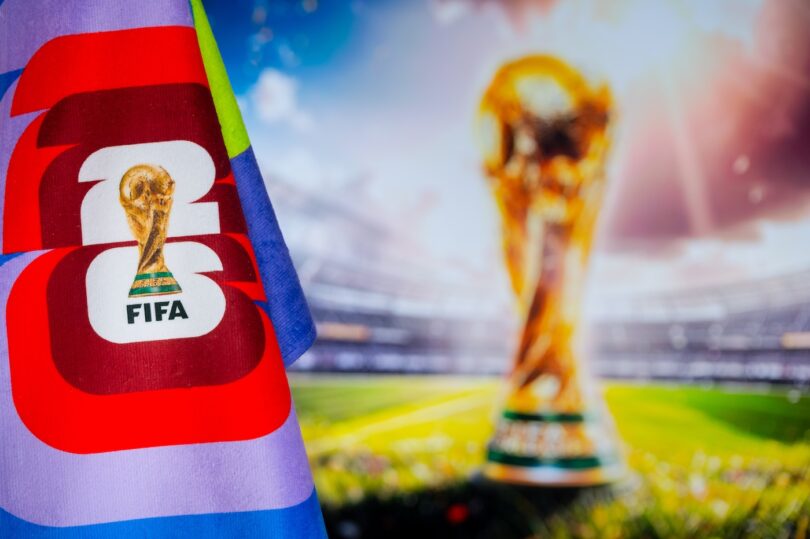
The last time a World Cup soccer tournament was held in the U.S. was in 1994. Thirty-two years later, the 2026 FIFA World Cup will take place June 11–July 19 in Canada, Mexico and the United States, with the final game set for New York New Jersey Stadium.
The tournament will feature 48 teams, double the number that competed in the 1994 World Cup. The athletes will play a total of 104 matches in 16 venues.
“More tickets will be sold, and at much higher prices,” said Jeff Bliss, who led the World Cup organizing committee and is now CEO of the Javelin Group marketing firm in Alexandria, Va. “There will be a lot more player- and team-sponsorship opportunities.”
Bliss moderated PRSA’s World Cup webinar on May 12, hosted by PRSA’s Sports & Entertainment Professional Interest Section. The larger number of teams and matches this year, and the three different countries where the games will be played, create logistical and transportation issues, language and cultural challenges, and political and security concerns, he said.
“The other issue is the lower quality of some of the matches in the first round,” he said. “Only four of those 72 matches will feature top-15 teams.”
But the largest controversy surrounding the 2026 FIFA World Cup involves ticket prices.
For example, the Portugal–Colombia game is averaging over $2,500 in buy-in — the upfront cost to enter the highest-demand ticket categories — with tickets reportedly listed for several million dollars.
A reason for hope
Nina Beeston is a London-based senior director of partnerships and public relations at THE·TEAM, a marketing and talent agency for sports, media and entertainment.
The expanded number of teams and matches for the 2026 World Cup brings “more opportunities for countries outside the traditional football powers and for their players, and that can only be a positive thing,” she said.
“The flip side is that teams competing don’t automatically mean more meaningful visibility for every player. It’s a lot harder to cut through when there are more matches, more storylines, and more players competing for attention.”
Panelist John Kristick is co-head of Playfly Sports Consulting. Before joining the company, he led the successful bid to host the FIFA World Cup 2026 in North America.
“The awareness of the sport in our country is as sophisticated and significant as any place in the world,” he said. “We’re very optimistic that this will go down as the greatest World Cup in history.”
Mark Levinstein runs a sports practice at law firm Williams & Connolly in Washington, D.C., and he is executive director of the players association for the U.S. Men’s National Soccer Team.
“The ticket prices are a concern, but kids will be inspired whether they watch it on television or they go to a game,” he said. “The biggest hope is that fans of soccer will get together with people who are not fans of soccer. They will celebrate, they will have parties, they will watch games, they will learn about the sport, and they will stay fans of the sport.”
A ‘toxic event’
Panelist Scott M. Reid is a sports and investigative reporter for the Orange County Register who has covered five World Cups. This year’s World Cup “is the most toxic event I’ve ever covered,” he said, pointing to ticket-pricing controversies and criticism of planning efforts by FIFA, the International Federation of Association Football. “It’s all negative, and there’s a lack of conversation on the actual tournament.”
Reid said there’s a tone-deafness to FIFA.
“They don’t understand the sophistication of the soccer market. That’s reflected in the ticket prices. The West Coast games are really poor. I think you’re going to have a hard time selling those matches to a sophisticated soccer audience. This is just another opportunity for FIFA to cash in.”
Panelist Patrick Wixted is a senior vice president at Ketchum Sports in Washington, D.C.
“I have a lot of clients like New Balance, MasterCard and PNG that are leveraging the culture of soccer around this time frame,” he said. “From a sponsor perspective, we’re trying to celebrate the game, celebrate the culture of soccer, and stand out from a sponsorship standpoint in a media landscape that’s as busy, and as fragmented, and as crazy, as ever.”
Photo credit: kovop58 — stock.adobe.com