
During PRSA’s ICON 2025 in Washington, D.C., Strategies & Tactics spoke with PRSA member Aliza Bran, director of media relations at the International Spy Museum. Our conversation continued beyond the pages of the February issue. As we enter the summer travel season, here are a few additional insights from Bran on connecting with diverse audiences, community engagement and preparing the next generation of communicators.
What are best practices for engaging an audience? How have you stayed in touch with the local community and visitors, and continued to reach a diverse audience internationally, following the challenges of the past few years with the pandemic?
[The pandemic] was awful, but we did learn one nice thing, which was that when our programming went virtual, there were people interested in interacting with us all over the world. When we came back to a post-pandemic world, a lot of our programming is now hybrid because there is a full audience that we have built that is all over.We recognize that people may want a podcast because they can’t just come to our programming whenever they feel like it. So, we have a podcast that comes out every Tuesday, where we dive into all sorts of burning intelligence questions of today. We talk to experts, historians.
We also have our specialty programming for audiences who may have difficulty coming during regular hours. We have all types of access programming to prevent the obstacles that may exist from getting in the way of someone enjoying their museum experience. For example, [with a neurodiverse] audience, we don’t want to have the lights and sounds going.
Our museum experience is very interactive. It’s bright and dark. It’s loud in moments. That’s what brings it to life for our audience, but that’s not always the right experience for someone, and we recognize that. So, we have two different days. One is for the family audience, and one is for the adult neurodivergent audience — that’s a group that we haven’t seen a lot of programming for.
People age out of this family programming audience, and then what? They’re adults who still have the same needs. So that was exciting, when a couple years after we created our first family programming, we realized we [needed to] address the older audience of the same community.
As far as our local community, D.C. is its own total environment in and of itself. We’re birthed here; we’ve been here for 23 years. We love being a part of the fabric of D.C. When events like the government shutdown occur, we recognize that they’re affecting our local community. So, we put together a 50% federal furlough discount. How do we show them that we care and we are part of this community? Because they’re part of our community — it’s finding ways to connect with audiences where they are.
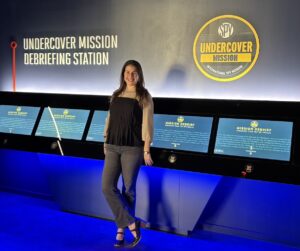
The International Spy Museum is doing some great education work in the community — with programs for memory care (Spy with Me), the neurodivergent community, hospitalized children, Title I Schools and even cybersecurity awareness tips.
We have someone who does our memory care programming, which is once a month for an hour online. It’s personalized. I’ve sat in on that programming before, and sometimes we have repeat goers, sometimes we have new people. It’s so open — it’s wonderful.
Then, [there’s] our partnership with WeGo. Several years ago, the group connected with us. They work with pediatric patients in hospitals — kids who certainly cannot just go and experience the museum, so we bring the museum to them. It’s a result of WeGo that we get to use these robots — they’re super cool. Ours is named Patrice, and the kids direct where the robot goes. Our Youth Education team will walk the kids through and give them the most exciting tour and talk about animal spies.
What’s great about this place is that people are so passionate about sharing knowledge and creating opportunities. It comes through in every sense of it. I feel fortunate to work with people who are so excited to do the work that they do.
We had our first-ever online exhibit on open-source intelligence, which speaks to all the information publicly available online. With that, there are some things that people probably should know about for their own cyber safety, right?
So, there are issues that we touch on without it necessarily being obvious, but once you get into the nitty-gritty, you realize they are in our purview. We want to make sure that whenever we’re diving into exploring these subjects, we’re helping people be better consumers of news or whatever it might be to live life in a more successful way for them.
How do you protect and promote important parts of history authentically — and real-life stories of intelligence officials — while also keeping the information fresh, fun, accessible and relevant to today’s consumers and a wide-ranging audience?
The Digital Learning HQ — the question is finding the right channel for it. In whatever industry you’re in, PR is something totally different — if your tool is a hammer, then everything looks like a nail. So, figure out what the right channel is for the story or information you’re working with is. Sometimes that’ll mean pitching an article to a specific group. Sometimes, that’s something that lives on your YouTube channel. Sometimes, it should be a podcast.
Look at each individual story and figure out where it will help you achieve your goals, and what your goals might be. It’s not just numbers for the sake of numbers. Is there something you want your audience to take away from it? How do you know if they took that away? Do you want someone to join as a member? Or [maybe it’s] tickets to the museum, or people attending a free program and knowing that you get to share some information. Everything looks different, and how you approach it should vary based on what you want to get out of it and what you want your audience to get out of it.
We have so many stories to tell. I don’t have enough time to [tell them] all, but that also means there’s so much to dig into. Sometimes it’s telling a story of a moment in history through the lens of today. And there are ways to refresh them naturally.
I did an article in 2019 with Refinery29 that was looking at Taylor Swift — whether the album was likely to come out, and what information an intelligence analyst might use to identify what might be going on using rumors intelligence, imagery intelligence — all these trappings of forms of intelligence. That’s a way that you take something a little older and make it new. You can do that with anything. At the time, I paying attention to Taylor Swift.
That’s part of the fun. You can bring a lot of this into today’s world, especially some of the more lighthearted stuff, and help people understand, because learning is much easier when you’re not seeing it happen. Then, try to figure out the truth from the noise. We talk about that in the “Fateful Failures” exhibit. How do you know what’s real and what’s extra?
You recently spoke on a panel about AI-powered media relations and what journalists and news influencers need from PR. Can you share some of those trends, tools and tactics — and what’s next for media relations?
AI is coming in as a massive piece of the PR landscape and of life, right now. We have to look at it as any other sort of technology. So, whether good or bad, if people are going to be using it, we need to consider how we’re going to interact with it. The same way that I look at how Gen Z and Gen Alpha turn to TikTok now as a place where they ask questions — that’s where they Google, right? So, we have to figure out if people are going to start Googling on the equivalent of a ChatGPT, and we need to know what ChatGPT is pulling.
When you’re doing your PR research, trying to figure out who you’re pitching — what media outlets and individuals — you want to know what’s being scraped by ChatGPT and other AI-related enterprises. That has to be part of the strategy behind it. We have to find audiences where they are, and if audiences are going to AI ventures, then we have to meet them there.
Below, Bran offers advice for PR’s next generation.
Exterior credit: Nic Lehoux, courtesy of RSHP
Image of Aliza Bran: Amy Jacques