
Register now for ICON 2026 in Orlando, Fla., from Oct.18-20.
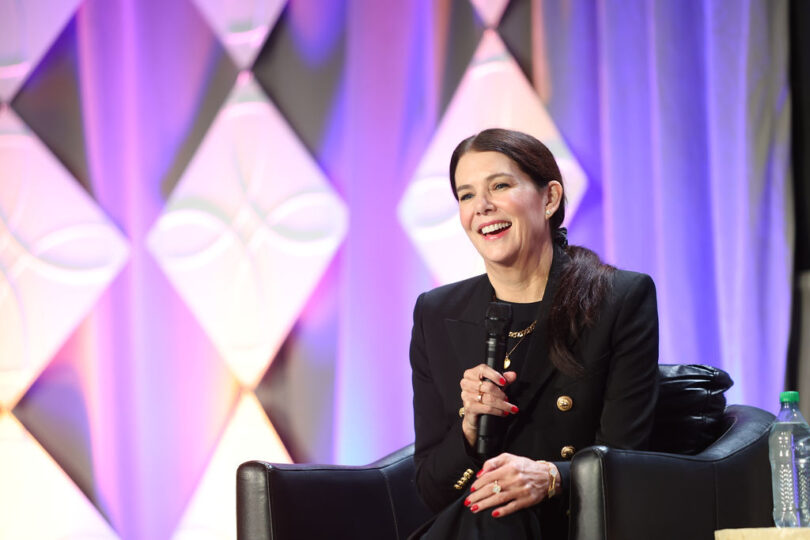
Actor, author and producer Lauren Graham headlined PRSA’s ICON 2025 in Washington, D.C., delivering an Oct. 28 keynote on the power of authentic storytelling.
Best known for her roles in “Gilmore Girls” and “Parenthood,” Graham spoke with Crystal Borde, co-chair of the 2025 PRSA ICON Conference planning committee, about her career and the creative forces that shape her work.
In this ICON interview with PRsay, she expands on those themes — reflecting on finding truth in character, connecting across generations and transforming personal stories into something universal.
You’ve built a career around storytelling through acting, writing and producing. What do you think are the keys to telling a good story, and what makes a story resonate with an audience?
For me, it’s something that’s personal, but I think relatable, when I’m telling the story. I remember getting feedback when I first started writing memoir and essays. I was asking someone’s advice, and they said, “I want to hear what you have to say, but I want to hear what you have to say to me.” So, it’s a way of making the personal universal.
But as an actor, I respond to all different kinds of stories. I was thinking today about how important reading was to me as a kid. And how, it started by being read to — like with my father, we read all kinds of things, but as I got a little older, we read “Oliver Twist.” I don’t relate to “Oliver Twist” necessarily, but there was something in the story of a child facing obstacles, or just what was exotic and unknown to me about it. So, I’m still kind of figuring it out. But it’s something that has heart, and a journey that feels worthy.
Here, Graham shares what she thinks makes a compelling story:
In “The Z-Suite,” you explore generational dynamics in the workplace, particularly how younger colleagues are rewriting the rules. What lessons do you think professionals of every age can learn from that story about staying relevant, adaptable and open to change, and bridging that generational gap?
That show was about the two generations not getting along. Because even in comedy, and in any kind of drama, of course, you need conflict. That would not be the way I would handle it — the way my character handled it. But I think it was sending up the idea that everyone thinks they have the way, or everyone thinks their way is correct, and everyone has something to mock in doing things differently.
In my life, it has been organic to the fact that I work with people of all different ages, and it is not necessarily built into the work I do that the senior person is the focus. Sometimes a 22-year-old is the lead of a show, and sometimes not. So, I have had a lot of experience kind of understanding that who is the boss is not necessarily a matter of seniority. And I’ve been lucky to have friends of all different ages; not just family members, but true friends who I consider peers, who might be 20 years older or younger than I am. And that, personally, has been helpful. So, I organically kind of understand new trends and lingo, and have a lot of respect for the people who came before me.
As a young actor, I was really interested in history. I was interested in how movies were made long before I was making them. I was interested in styles of acting that came before me. That’s something you hope for everyone at every stage — that they are interested in where someone is coming from. But with make friends, in a corporate situation, I’m sure you have more boundaries in terms of if you want to, or need to, socialize outside of work.
And, technology is always its own issue, right? Because that separates how you grew up. I grew up with no phone, and my dad didn’t know where I was for hours at a time, and that was fine for me. It’s just different now. I don’t think any of us know what AI is going to do just yet. We just saw the first AI actor looking for representation — I don’t know if you saw that article — and we all broke out in a sweat.
Fans often say your characters feel real because they sound authentic. How do you find and protect an authentic voice, and what advice would you give communicators trying to help others do the same?
Well, it’s a little different for me, because I’m inhabiting somebody else’s work, but those jobs find the people who can convey what the writer intended. I’ve just been lucky to live in these dramatic stories that have some comedy to them as well, which is true to how I speak, how I write, how I am.
Somehow, my work as a writer runs parallel to some of the characters I’ve gotten to play. That’s just how it worked out. I don’t know why Daniel Day-Lewis comes to mind — like what his book would feel like. I’ve always been interested in Steve Martin’s fiction, which does not sound like the Steve Martin we know and think of as a comedian. So, I think I just have an ear for dialogue and for how people talk, and that’s how I try to write as well.
Finding your voice is a matter of practice. If it’s not organic — I feel so much more surefooted as a writer now — listen to the first thing that comes to mind or the first idea for a story. And those instincts have been honed by practice.
“Talking as Fast as I Can” became part of your personal brand. What have you learned about the rhythm and honesty of dialogue — and how can communicators apply that to make their messages more human and memorable?
In the case of the show Gilmore Girls, there was an alignment that you hope for. I read this dialogue, and I felt like I heard it in my head — like a song I knew a little bit already. So, that was just a good connection, between writer and actor. And it is organic to the way I speak and has ended up feeling a little bit the way I write.
You’ve written both fiction and memoir. How does your approach to storytelling change when you’re writing as yourself versus writing a character? What can PR pros take from that distinction when crafting thought leadership or brand stories?
Well, I enjoy fiction, because I’m playing all the characters, which, to me, is how I started as an actor — acting out a scenario, with my stuffed animals or whatever. How I approach it structurally is very different. How I have worked in memoir is the titles come to me, and a subject, and I wonder if I have enough material to make it into something universal and relatable.
In fiction, I am starting more with the situation, and a journey I want to see the character go on. Again, I get to sort of play all the characters. In both cases, it is a matter of the discipline of letting something be imperfect the first, second and third time around, and just putting down a rough idea — and not being afraid to have that idea be rough, unformed, not where you want it to be yet — and trust that there’s something in there that will emerge the more you work on it.
So, in both cases, it’s just getting out of the way of “this is a bad idea, and no one will understand this,” and continuing until you at least have a beginning, middle and end. Then you can look at: “Am I communicating in the way I really meant to? Or is there something else here?”
I find rewriting much easier than writing. But it’s getting through that first level of uncertainty. My editor always says to me: “I can’t edit a blank page,” just put something down that is the rough idea of what you’re trying to say.
Here, Graham discusses her writing journey:
Amy Jacques is the managing editor of Strategies & Tactics.
Photo credit: albert chau