

Communications campaigns “can’t put people in a box anymore,” said Monique Soriano-Foreman, an account director at Burson in New York.
“You can’t just say, ‘I want to make this program for Hispanic women or for Black men,’” she said. “It’s not just about the Hispanic woman — it’s the Hispanic woman who is married to a woman. It’s the Black man who is also Jewish. Leaders have to be more diverse in their thinking and open-minded in order to succeed.”
Soriano-Foreman was a panelist for “The Next Era of Leadership: Black Voices Shaping the Future of PR,” PRSA’s webinar held on Feb. 24. Hosted by Sabrina Browne, co-chair of PRSA’s Black Voices Affinity Group, the discussion explored how leadership expectations are evolving across generations, identities and media environments.
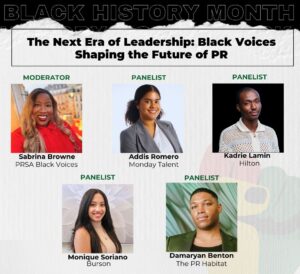
Browne said she agrees with “those themes of individuality with inclusion but also intersectionality. There are so many aspects that make up the individual.”
That recognition of complexity — and the responsibility it entails — was a recurring theme throughout the session.
Media Literacy and Moral Alignment
Addis Romero, a senior studying strategic communications at Morgan State University in Baltimore and a research intern at the agency Monday Talent, emphasized that leaders must sharpen their media literacy and influencer-vetting processes.
“There is a new responsibility of influencer-vetting and being media literate,” she said. For communications leaders, “not only do you need to be inclusive, but you also need to do your research, which a lot of companies are missing and some PR professionals are lacking. That’s why we’re seeing backlash from viewers that can damage your brand’s reputation if you don’t go through that influencer-vetting process.”
Romero added that Gen Z is reshaping expectations for brands and employers alike.
“Because we are so deeply politically and socially aware, we expect the brand to follow that,” she said. “Morality shapes how we engage, whether with the workforce or in our media. If a brand’s ethos does not align with what we believe in, we’ll actively choose to not engage with it.”
Her message was clear: values alignment is no longer a differentiator — it is a baseline expectation.
Mentorship Is Important. Sponsorship Is Essential.
Kadrie Lamin, manager of brand communications for Hilton in Washington, D.C., said senior leaders must move beyond traditional mentorship models.
“Mentorship is obviously very important, but sponsorship is even more essential,” he said. “It happens when leaders actively advocate for talent, especially when that person may not have a voice or a seat at the table. That advocacy can be game-changing. I’ve experienced it firsthand.”
Sponsorship, Lamin explained, is about “using your influence to open doors” — not just offering advice but recommending emerging professionals for opportunities and elevating their visibility.
Damaryan Benton, an account executive at the Los Angeles advertising agency Anomaly and founder of The PR Habitat, a nonprofit networking group for young communications professionals of color, said today’s leaders face a more complex landscape than previous generations.
“Previous generations navigated media cycles, reputation management, digital transformation, and how to utilize all those tools,” he said. “Today’s leaders and future leaders also have to navigate algorithmic bias within creator economies and the political polarization.”
Campaigns now demand sharper ethical scrutiny, he added. “What are we asking? Who does this harm? Who does it benefit?” If those questions go unanswered, “It can lead to real-time backlash and people feeling misrepresented.”
“We want to make sure that Gen Z presence and representation are accurate,” Benton said. “If it’s not going to be a Gen Z person leading it, we don’t align with that. We should know what we stand for and what we will not accept as the standard in our industry. Future leaders are excited to take on that challenge.”
Closing the access gap
Several themes stood out during the session.
The next generation of Black leaders remains resolute and resilient amid uncertainty. They are not naïve about the challenges within the profession — from access barriers to structural inequities — yet they are clear-eyed and focused on growth.
Panelists underscored that advancement cannot rely on talent alone. Exposure, internships, sponsorship and investment all matter. There is still urgent work to close the access gap, particularly by expanding opportunities for Black students at HBCUs and at institutions that do not traditionally feed into the communications profession.
There was also a strong call to upskill Black talent — and all young professionals entering the field — through meaningful mentorship and true sponsorship. Advancement requires more than skill. It requires advocacy.
As the discussion made clear, the next era of PR leadership will demand intersectional thinking, moral clarity, media literacy and structural commitment to access. Representation alone is not enough. Leadership must be intentional, accountable and inclusive by design.
Illustration credit: Arkan